

Should we measure gases, leaks or both?
In the food industry, ensuring the quality of packaging is not just about checking that the product has been packed correctly. It is also essential to ensure that the storage conditions will be maintained throughout the product’s lifetime.
For this, two tests are commonly used: gas analysis and leak testing. But which one should be preferred? The answer depends on the type of packaging and the information required.
Why measure gases?
The analysis of gases makes it possible to check the composition of the atmosphere present inside a package.
In modified atmosphere packaging (MAP), manufacturers mainly control:
- Oxygen (O 2)
- Carbon dioxide (CO 2)
- Nitrogen (N 2)
This measure allows in particular to:
- Check that the packaging machine is working properly
- Confirm that the injected gas mixture complies with the specifications
- Detecting a production drift
- Ensure the intended storage conditions for the product
Gas analysis therefore answers a simple question: was the protective atmosphere created correctly?
Why measure leaks?
The presence of the correct gas mixture in the packaging is not always sufficient to guarantee its quality.
Indeed, packaging can be compliant during packaging but have a micro-leak that may gradually degrade its performance.
The tightness test makes it possible to detect:
- Welding defects
- Imperfect operculation
- Perforations in the material
- Micro-leaks invisible to the naked eye
It answers another essential question: is the packaging able to retain its protective properties over time?
Why is gas analysis not always enough?
Let’s take the example of a tray of fresh meat in a modified atmosphere.
Immediately after packaging, the inspection shall indicate:
- A compliant oxygen rate
- A compliant CO2 rate
- An atmosphere perfectly in line with the specifications
However, if a micro-leak is present, the protective atmosphere can gradually deteriorate during storage or transport.
A few days later:
- Oxygen can enter the packaging
- CO2 can escape
- The shelf life can be reduced
- The quality of the product may be altered
The gas analysis is therefore a photograph at a given moment, while the leak test allows us to assess the packaging’s ability to retain this atmosphere over time.
Which control to choose according to the packaging?
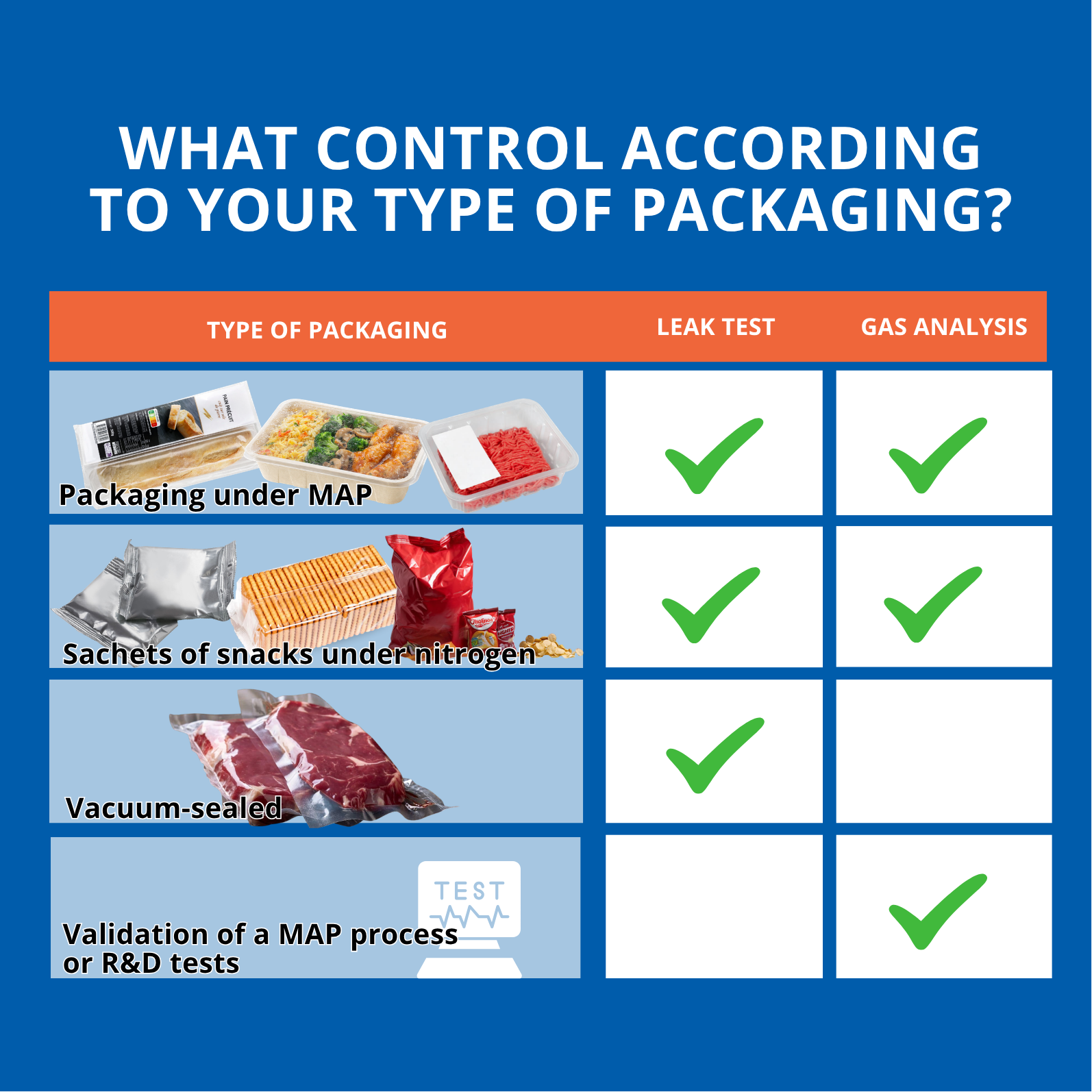
In practice, when should we do both?
For most modified atmosphere packaging, the inspections are complementary.
The gas analysis makes it possible to verify that the correct mixture has been injected during conditioning.
The leak test verifies that this mixture will remain present until the product is consumed.
This dual approach is particularly relevant to:
- Fresh meats
- Fish and seafood
- Deli meats
- Cheeses in a modified atmosphere
- Ready-made dishes
- Salads and plants packaged under MAP
Conclusion
There is no one-size-fits-all method for packaging.
For vacuum products, the leak test is often a priority. For development tests or the validation of a MAP process, gas analysis may be sufficient.
However, for the majority of products packaged in a modified atmosphere, gas analysis and leak testing are complementary.
Measuring gases allows you to verify that the correct atmosphere has been created. Measuring leaks ensures that it will be preserved until consumption. Together, these two tests provide the most complete picture of food packaging quality.
To find out more, take a look at our white paper: What an atmosphere!