

Is the water basin test still sufficient to guarantee packaging quality?
For decades, the water basin test has been widely used to detect leaks in food packaging. Simple to perform and inexpensive, it remains in use today in many quality control departments.
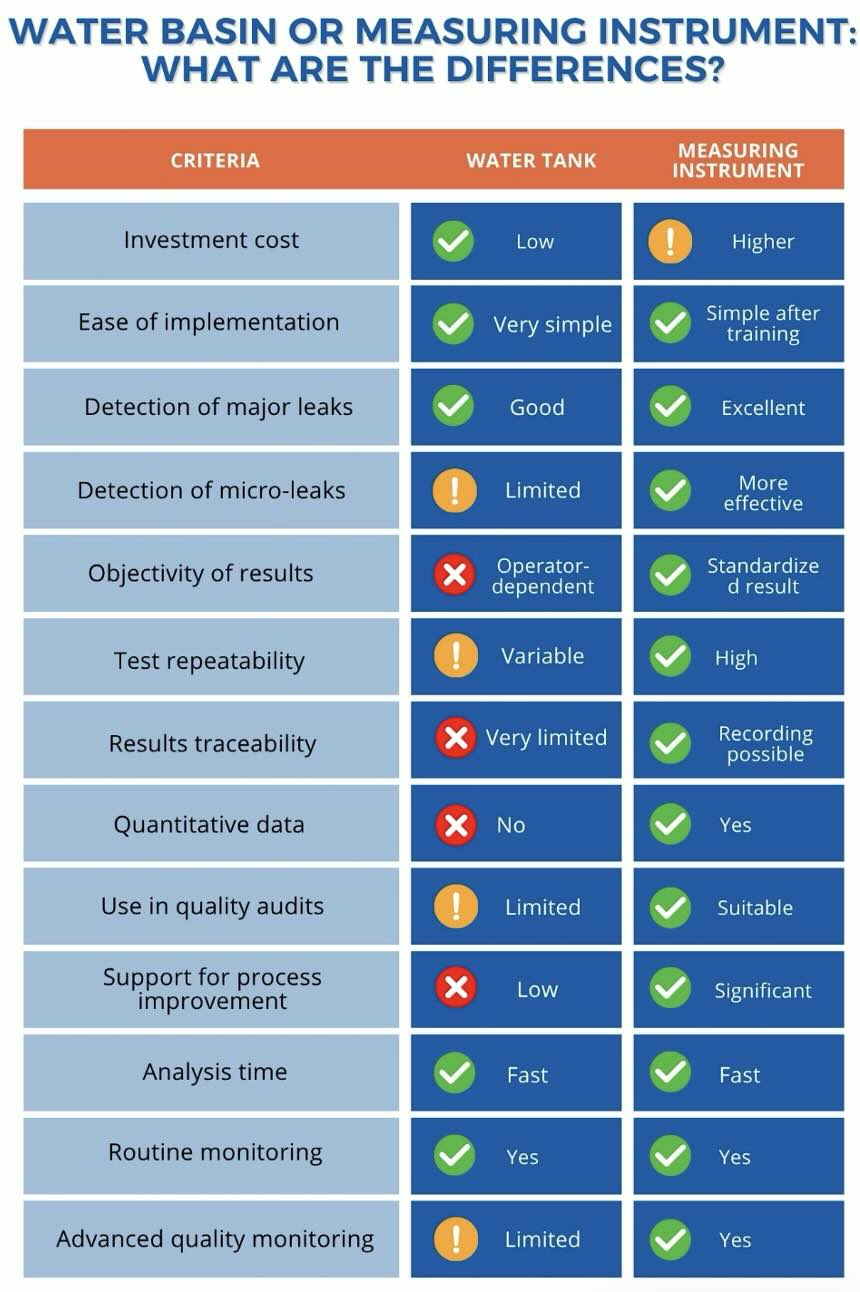
But given the food industry’s growing demands for traceability, repeatability, and process control, is this method still sufficient? And what advantages do modern measuring instruments offer?
How does the water basin test work?
The principle is relatively simple.
The package is submerged in a tank filled with water and then subjected to a vacuum. If there is a leak, the gas inside the package escapes in the form of bubbles visible on the surface.
This method is frequently used to test:
- Sealed trays
- Flexible pouches
- Modified atmosphere packaging (MAP)
- Vacuum-sealed packaging
Its main advantage is that it allows for direct visualization of certain leaks without requiring complex analysis.
Why this method is now reaching its limits
Manufacturers’ expectations have changed significantly in recent years.
Quality managers are no longer simply looking to determine whether packaging has a visible leak. They also want to:
- Obtain reproducible results
- Compare production batches
- Monitor the performance of a packaging line
- Document the inspections performed
- Meet audit and certification requirements
However, the water basin test has certain limitations when it comes to meeting these objectives.
Micro-leaks: A unique challenge
Some leaks are large enough to produce a clearly visible stream of bubbles.
Others are much more subtle.
These micro-leaks can, however, have significant consequences:
- Gradual loss of the protective atmosphere
- Oxygen entering the package
- Reduced shelf life
- Deterioration in the product’s appearance or taste
- Increased risk of customer complaints
The higher the preservation requirements, the more critical the ability to detect these defects becomes.
The true cost of an undetected leak
When defective packaging leaves the factory, the consequences can far exceed the cost of a single lost package.
A leak can result in:
- Non-compliant products on store shelves
- A reduction in the actual best-by date
- Customer returns
- Financial losses
- An increase in food waste
- Damage to the brand’s image
In this context, quality control is no longer aimed solely at detecting defects, but also at preventing risks throughout the supply chain.
Anéolia solutions for packaging inspection
For over 20 years, Anéolia has been developing solutions dedicated to the inspection of food packaging under modified atmosphere and vacuum conditions.
The range of instruments enables, in particular:
- Analysis of gases present in packaging
- Leak testing
- Traceability of test results
- Recording and analysis of measurement data
- Continuous improvement of packaging processes
Most methods used to measure gases or assess leak tightness rely on destructive testing, which requires sampling or altering the packaging being tested.
However, certain applications require that the product’s integrity be preserved after testing. To meet this need, Anéolia also offers the Oxylos® Non-Destructive, a solution that measures oxygen through certain types of packaging without piercing or damaging them. Users can thus perform multiple measurements on a single sample while keeping it market-ready.
Manufacturers thus have access to solutions tailored to different needs, whether for traditional destructive testing or non-destructive measurements when preserving the packaging is a major concern.
Conclusion
The water basin test remains a simple, cost-effective, and widely used method for detecting certain packaging leaks.
However, current requirements for quality, traceability, and repeatability are leading more and more manufacturers to rely on instrumented methods. These methods provide more objective results, better defect detection, and actionable data to sustainably improve packaging processes.
The choice of method will therefore depend on the desired level of quality, the risks associated with the packaged products, and the company’s quality control objectives.