

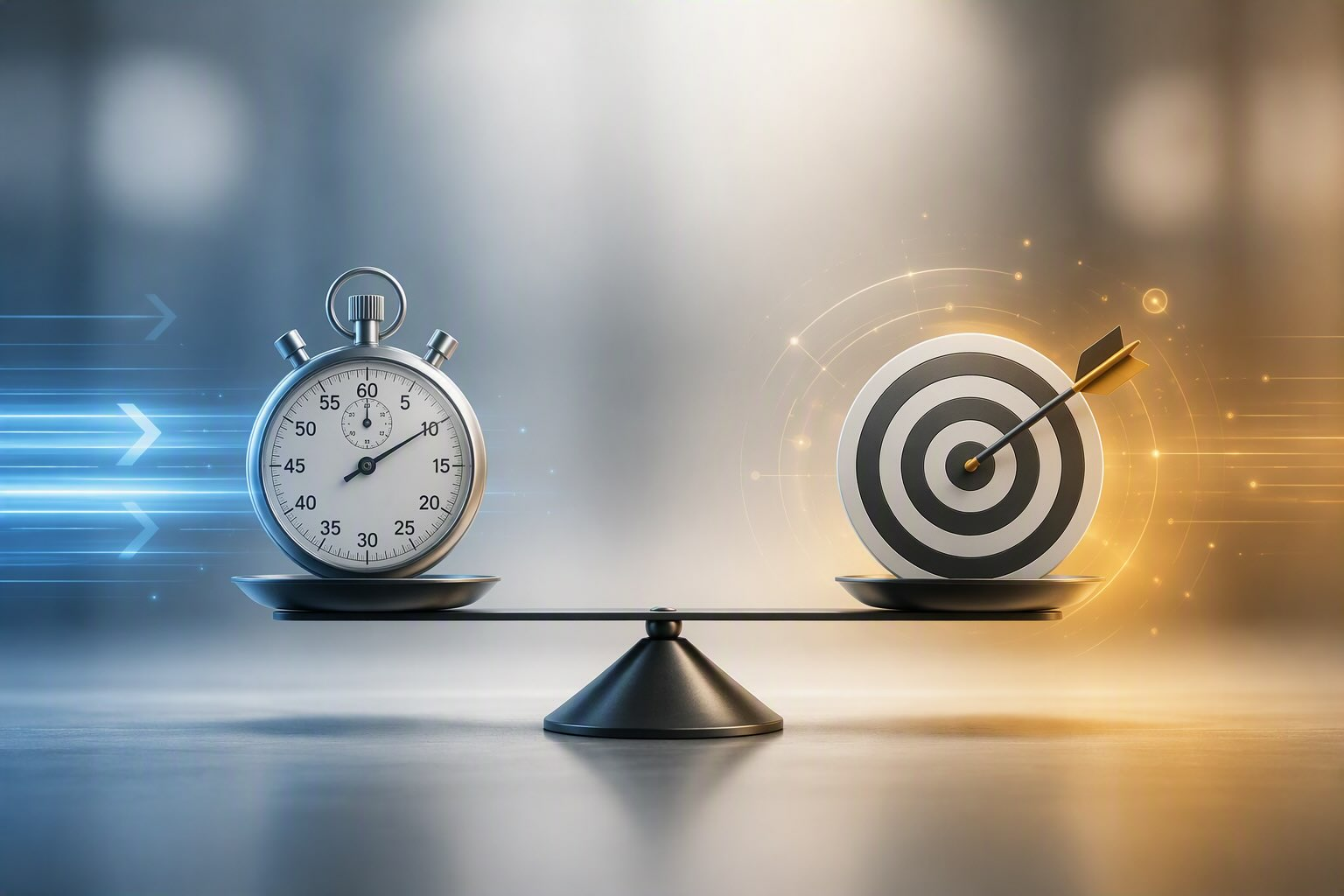
Is it necessary to choose between test speed and measurement accuracy?
In industry as well as in laboratories, there is a widely held belief: the faster a measurement is, the less accurate it is. Conversely, obtaining reliable results is thought to inevitably take more time. But is this dichotomy still relevant today?
A compromise that was long considered unavoidable
For years, measurement systems did indeed have to strike a balance between execution speed and metrological accuracy.
From a physical and mathematical perspective, this constraint is based on several fundamental principles:
• Integration time and the signal-to-noise ratio: ultra-fast data acquisition reduces the volume of data captured per sample, making the measurement particularly vulnerable to background fluctuations and parasitic interference.
• The stabilisation of thermal and mechanical phenomena: many measurement principles require a state of physico-chemical equilibrium (pressure, temperature, mass transfer) to be reached before a stable value can be obtained.
• Measurement statistics: obtaining a representative average value used to involve repeating the acquisition cycles multiple times to smooth out the variance.
In this context, reducing test time inevitably meant accepting a higher level of expanded uncertainty or compromising the instrument’s resolution.
Changing industrial requirements
Today, manufacturers must make decisions ever more quickly. 100 per cent quality control on the production line, closed-loop control, and the reduction of cycle times and downtime: having reliable real-time information has become a strategic performance driver.
The question is therefore no longer simply: ‘Is this measurement absolute and ultra-precise? ’
It is now: ‘Does this measurement offer sufficient reliability and accuracy to validate an immediate decision, without the risk of false acceptances or false rejections?’
New technologies are changing the game
Combined advances in sensor physics, signal processing and embedded electronics have profoundly redefined the rules of modern metrology.
The latest-generation instruments are based on concrete advances:
• High-dynamic-range sensors: featuring increased sampling rates and optimised physical sensitivities to capture useful data from the very first milliseconds.
• Advanced digital processing: the integration of adaptive filtering, deconvolution and predictive modelling algorithms enables the final equilibrium value to be calculated even before the physical phenomenon has fully stabilised.
• Real-time multi-parameter compensation: instantaneous accounting for environmental drifts (atmospheric pressure, ambient temperature, humidity) corrects systematic errors on the fly.
• Elimination of human bias: the complete automation of measurement-taking and data flow management minimises uncertainties arising from inattention or handling errors.
Measurement speed is therefore no longer synonymous with a loss of metrological rigour.
True performance: combining the two
A highly accurate but excessively slow instrument inevitably creates logistical bottlenecks and hampers industrial throughput. Conversely, fast but unstable equipment raises doubts, increases the cost of non-conformity and undermines traceability.
True performance lies in controlling overall uncertainty within a minimal cycle time: delivering a highly reliable measurement immediately.
It is precisely this approach that guides the development of new measuring instruments.
Elyos: speed without compromise
With the elyos®, Anéolia addresses this fundamental challenge by combining advanced analysis speed with metrological control.
Thanks to an architecture designed to maximise acquisition dynamics and make the most of intelligent data processing, the elyos® enables users to obtain fully usable and traceable results in a matter of seconds, without compromising on accuracy and repeatability.
The aim is no longer to choose between speed and accuracy, but to benefit from both simultaneously in order to accelerate decision-making and optimise day-to-day operational performance.
Discover more about the elyos, click here